
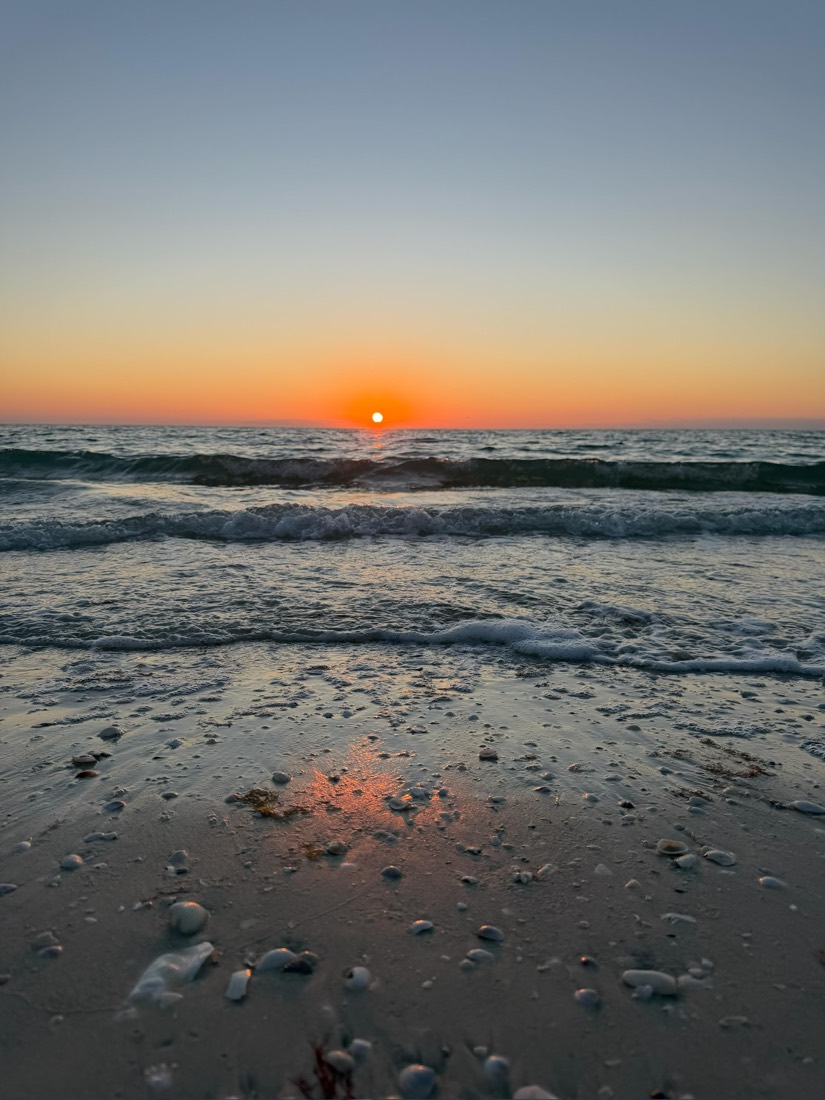
🏝️ At a glance
- Access
- Drive-up state park; tram or walk to the beach
- Make-up
- Four barrier islands, bays & estuary behind
- Wildlife
- Manatees (cool season), dolphins, roseate spoonbills
- Best haul
- Low tide after a winter front
- Rule
- Lee County — empty shells only
Getting there: drive up, tram in
Lovers Key State Park sits between Fort Myers Beach and Bonita Springs, just north of Bonita Beach. You drive into the park, leave the car, and a free tram shuttles you across the boardwalk to the Gulf sand — or you can walk it if you'd rather take in the mangroves. That short buffer between the lot and the beach thins the crowd compared to a curbside beach, so the shell line holds up a little better through the morning.
It's still a public state-park beach, though, so for the genuinely untouched wrack you'd want a boat. Our shelling tours run that play closer to Marco, dropping you on boat-only islands like Keewaydin where the tide does all the restocking.
What washes up at Lovers Key
Expect the dependable Gulf line-up: fighting conchs, lightning and knobbed whelks, lettered olives, scallops, cockles and coquinas, with better numbers near the passes where current concentrates the drift. After a real front, deeper shells get pushed up and the odd whole lightning whelk shows up before the day-trippers arrive.
Wildlife while you shell
This is the part that sets Lovers Key apart. The estuary behind the islands is rich water, so it's normal to glance up from the shell line and spot a dolphin rolling through the pass or a flash of pink that turns out to be a roseate spoonbill working the shallows. In the cool months — roughly November into March, when the water dips — manatees move into the warmer back bays. They're not herded up Crystal-River style here, but a quiet paddle or boat ride gives you a real shot. It's the same wildlife our captains read every day on the dolphin tours out of Marco.
| Critter | When | Where to look |
|---|---|---|
| Bottlenose dolphin | Year-round | The passes & nearshore Gulf |
| Manatee | Cool season (~Nov–Mar) | Warmer back bays & canals |
| Roseate spoonbill | Year-round, best fall–spring | Estuary shallows |
Best tide and season
Shell the low tide and chase the fronts. The richest lines at Lovers Key follow a winter cold front or strong onshore wind that churns up fresh shells. Winter into spring stacks the deck — more fronts, cooler water, peak wildlife, fewer crowds. And keep it legal: Lovers Key is in Lee County, so it's empty-shells-only. Check every shell for a living animal before it goes in the bag, and never take a live sand dollar or starfish.
From the Helm: Idling through Estero Bay’s manatee zone to Lovers Key’s Gulf beach at low water
About half a mile inside Big Carlos Pass, the water drops out of open Gulf chop into the flat calm of Estero Bay almost all at once, and that’s usually where we bring the throttle back for good and leave it there. A posted manatee zone runs most of the length of that bay, so from that point until we’re within sight of Lovers Key we hold idle speed the entire way, whether or not anyone’s spotted one yet, because the rule doesn’t wait for a sighting to matter. It’s slower than guests expect on a boat, and that’s exactly the point of the zone.
That slow stretch actually works in our favor more often than not. Idling gives everyone aboard time to actually watch the mangrove shoreline instead of just staring at a phone or a GPS screen, and it’s usually where a first dorsal fin, a wading heron, or a roseate spoonbill gets spotted well before we’re anywhere near the beach itself. We keep a hand near the throttle the whole way, ready to ease off further if something surfaces close, since slow through that bay is the standing rule, not a suggestion we follow only when convenient.
We time the landing for low water on a falling tide, when the sandbar fringing Lovers Key is showing its widest and we can read the depth by eye instead of guessing at it. Guests step off into water that barely covers the ankles most mornings, and because we’ve already idled the whole run in, nobody’s rattled or seasick by the time the ladder goes down — which matters more here than at some of our rougher outside-bar landings.
When a stiff onshore wind is working against us at Big Carlos Pass on the way out, we’ll sometimes flip the order and run the inside route past New Pass first, saving the open-water stretch of the crossing for later in the morning once conditions have had a chance to ease. It costs us a little time on the front end, never the trip itself, and it keeps the ride comfortable for guests who came aboard for shells and wildlife, not for a bumpy, spray-in-your-face crossing they didn’t sign up for.
A morning like this pairs naturally with our dolphin tours, since the same slow idle through Estero Bay that protects manatees also happens to be some of the best water on our whole run for spotting a fin working the pass. If Lovers Key’s tram-and-parking-lot version sounds easier than a boat day, that’s a fair call — the version we run just skips the lot, the tram, and the crowd entirely.